Desktop devices a
recommended.

Register Now
ABMDI Continuing Education Credit Hours: 1.75
Cost: $49
Self-paced online course
Access time to complete: 6 months
Already registered? Please login.
High schools
(click here)
About the Evidence-based Thinking Course
This is an interactive, self-reflective course.
Assess different visual and case scenarios.
Then check your thinking.
Gain skills to manage internal and external influences and pressures during evidence analysis, including
- assumptions
- bias
- prejudice
Practice with real autopsy casework.
Think you see the world without bias? Don’t have any prejudices?
Take the course and find out.
Integrate skills that work for you.
Preview
(Desktop recommended)
End of preview
Course Outline
Introduction – Evidence-based thinking
Preface
Introduction
Introduction
Welcome
Terms of use and Privacy
Course level
Note to death investigators
Viewing the course
About the video
Completing the course
Terms of use and Privacy
Course level
Note to death investigators
Viewing the course
About the video
Completing the course
Evidence-based thinking
Pre-test
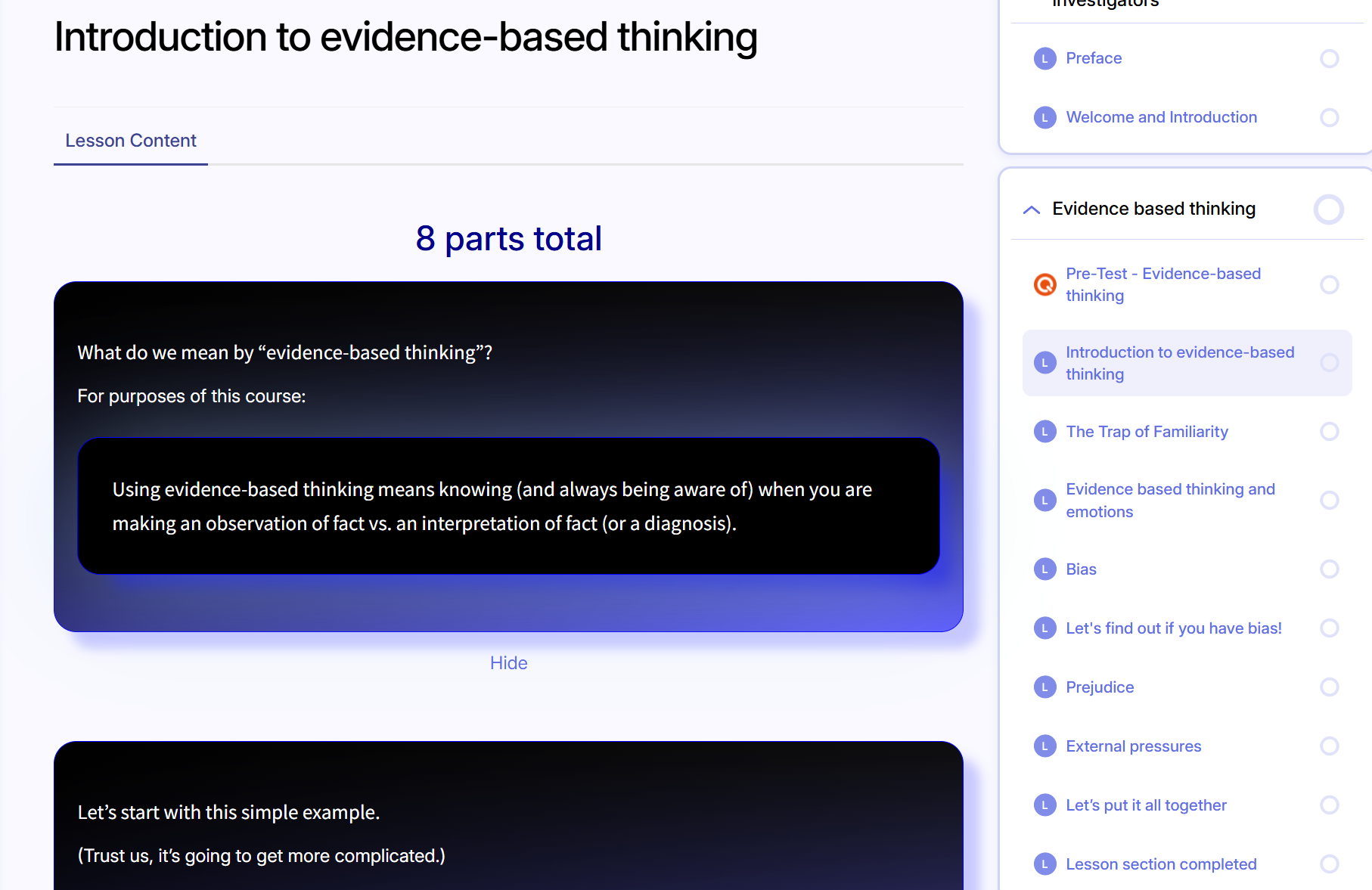
Introduction to evidence-based thinking
Introduction to evidence-based thinking
What is evidence-based thinking?
Example illustration
Evidence-based thinking activity
Assessment
Discussion – 1
Discussion – 2
Discussion – 3
Comment and summary
Example illustration
Evidence-based thinking activity
Assessment
Discussion – 1
Discussion – 2
Discussion – 3
Comment and summary
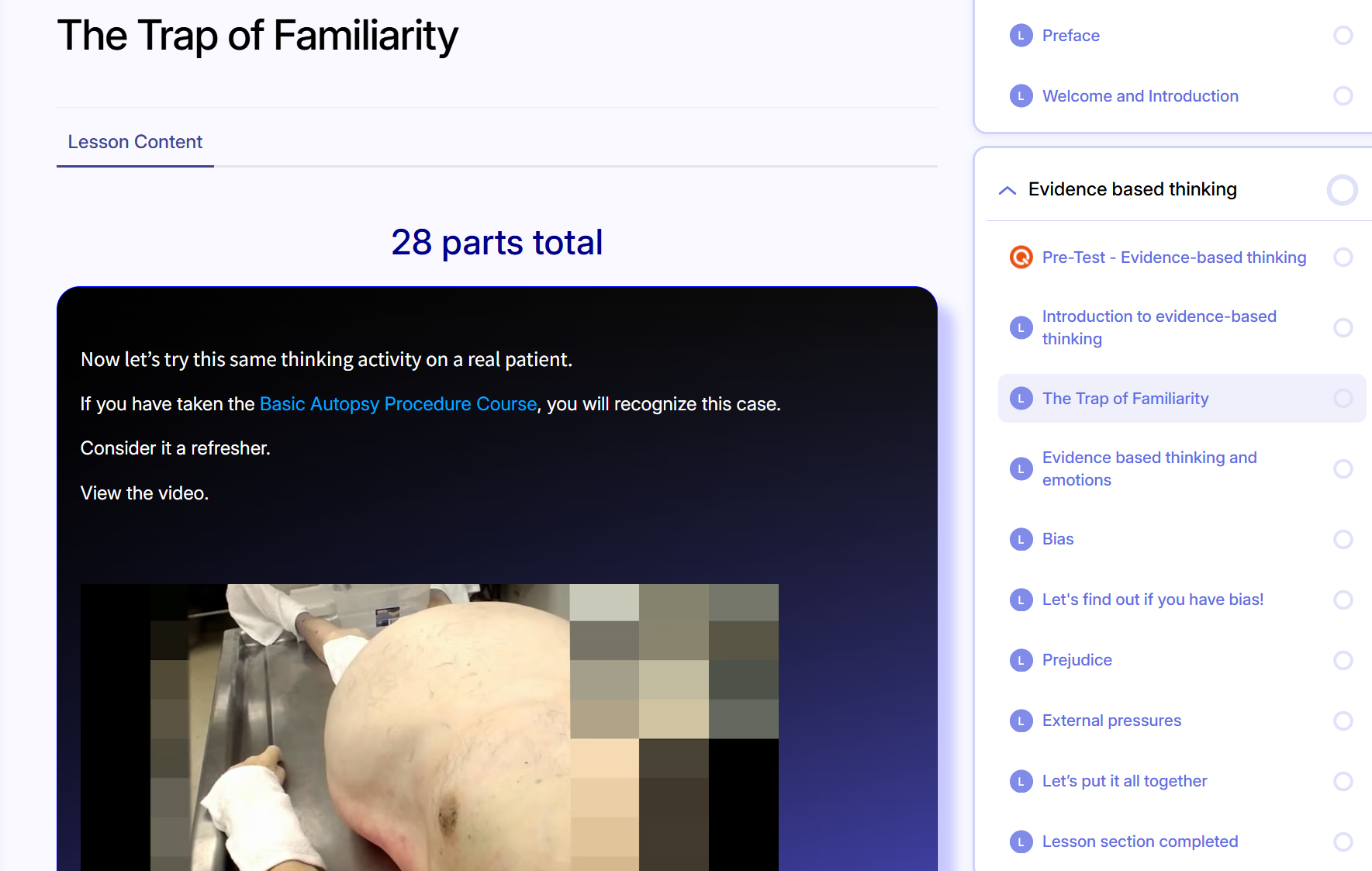
The Trap of Familiarity
Real-case example illustration
Evidence-based thinking activity
Assessment
Discussion
Re-assessment
Discussion – external exam
Introduction of terms: “Trap of Familiarity”
You’ll have company inside the trap, but can get out!
Valuing first impressions
Tips to counter the Trap of Familiarity
More tips – practical
Summary
Feelings – challenge yourself to be humble
Continued case example – internal exam
Assessment
Discussion
Continued case example – more internal exam
Assessment
Discussion – 1
Discussion – 2
Why are first impressions natural?
Why forensics and medicine are specialized fields
Causes to explain case findings
Challenge
Next tip for countering the Trap of Familiarity
Summary
Let’s get personal!
Summary skills to enhance evidence-based thinking
Introduction to emotions
Evidence-based thinking and emotions
Intellect combines with emotion for evidence based thinking
Introduction of next example
Discussion of next example
Image for evidence-based analysis
Evidence-based assessment
Discussion
Introduction of next example
Discussion of next example
Image for evidence-based analysis
Evidence-based assessment
Discussion
Bias
Introducing the next image
Image for evidence-based analysis
Evidence-based assessment
Discussion
What do you think “bias” means?
Our definition of bias
Bias compared to the Trap of Familiarity
Why does bias occur?
Image for evidence-based analysis
Evidence-based assessment
Discussion
What do you think “bias” means?
Our definition of bias
Bias compared to the Trap of Familiarity
Why does bias occur?
Let’s find out if you have bias!
Your case study: motor vehicle accident
Your first assessment
View the external exam
Sketch and take notes
Revisit your assessment
Evidence-based thinking activity
Your second motor vehicle accident
Sketch and take notes
Compare cases
Self-assess
Discussion – find out if you have bias!
Your first assessment
View the external exam
Sketch and take notes
Revisit your assessment
Evidence-based thinking activity
Your second motor vehicle accident
Sketch and take notes
Compare cases
Self-assess
Discussion – find out if you have bias!
Prejudice
Impact of prejudice
Let’s shine a light on you
What is prejudice?
Let’s shine a light on you
What is prejudice?
External pressure
Why people stray from evidence-based thinking
Pressures at work
Fears and threats
You will always be respected for using evidence-based processes
Encouragement
What you can say when you are feeling pressured
There’s a lot more to talk about!
Pressures at work
Fears and threats
You will always be respected for using evidence-based processes
Encouragement
What you can say when you are feeling pressured
There’s a lot more to talk about!
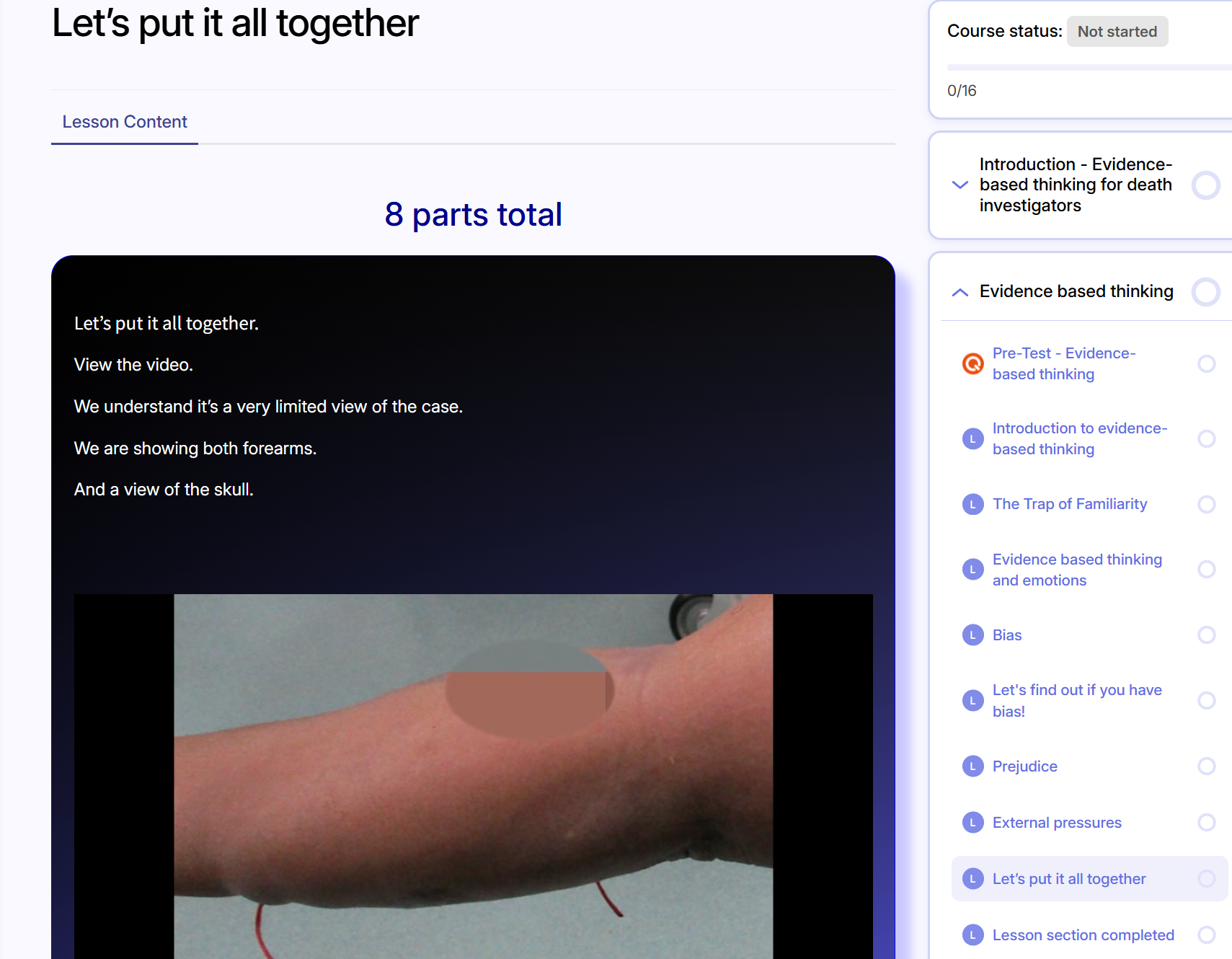
Let’s put it all together
Assessment of new case (trauma)
What’s the manner of death?
What’s your assessment
Tip for people earlier in training
First hypothetical — what’s your assessment
Second hypothetical — what’s your assessment
How does race affect your view of the case?
Summary goals of case
What’s the manner of death?
What’s your assessment
Tip for people earlier in training
First hypothetical — what’s your assessment
Second hypothetical — what’s your assessment
How does race affect your view of the case?
Summary goals of case
Lessons section completed
Assessment
Important! About the Assessment
Tip: How do I check if I marked every lesson complete?
Assessment
Course evaluation
Tip: How do I check if I marked every lesson complete?
Assessment
Course evaluation
Appendices
Appendix 1 – Additional Reading
Appendix 2 – About the last case. Tip for newer professionals.
Appendix 2 – About the last case. Tip for newer professionals.